

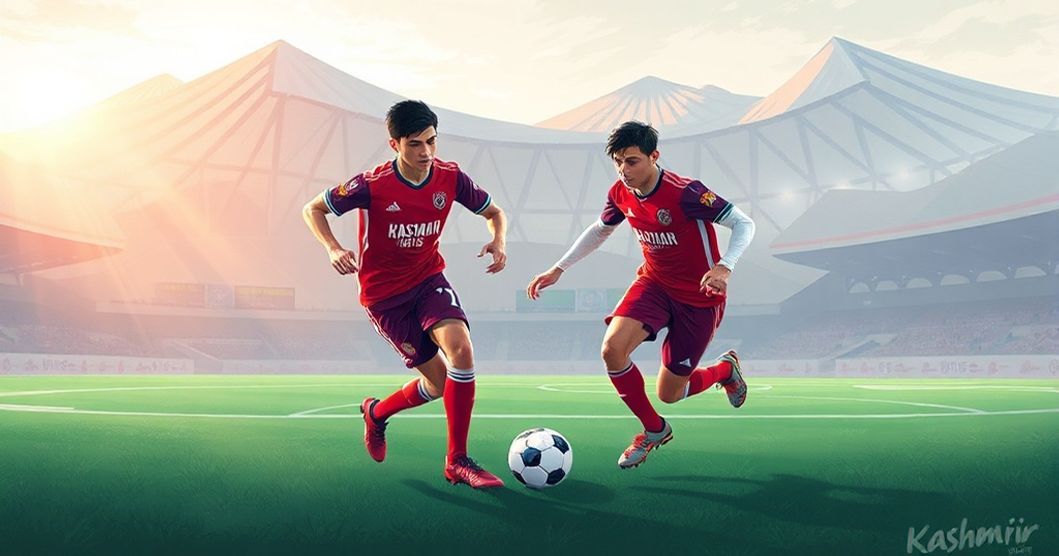
There is a gentle, alluring urgency present in Mohammed Zeeshan Ayyub and Manav Kaul’s, Real Kashmir Football Club. Directors Mahesh Mathai and Rajesh Mapuskar cast a sensitive and often informed gaze at what makes and breaks the valley.
They look at the conflicted state and its people beyond their immediate hassles of being crushed in the crossfire between the army and the militants. The tenderly designed visuals situate them in the everyday life of Srinagar, moving beyond the familiar images of Dal lake, Lal Chowk and Chinar trees, popularised by Hindi films over the years.
There is a concerted effort to look at the bustling by-lanes where an old salon still stands, a butcher goes about his work, a basket of Lavasa bread rests on a man’s head, and people casually stroll along the streets. The real Kashmir here is not only tending to its wounds but also basking in the afternoon sun, comforted by a cup of Kahwa. One among the many is Sohail Meer (Zeeshan), a disgruntled journalist, who decides to leave his job and bring some meaningful change to the lives of youngsters in the valley by creating a football club.
After some discouraging responses from a handful around him, Sohail meets Shirish Kemmu (Manav), a liquor businessman, who is facing the wrath of a conservative leader, Nazir Dar (Adhir Bhat) for corrupting the minds of people in the valley. After some consideration and negotiation, Shirish agrees to fund for the club as Sohail promises him to get the players and a coach.
Real Kashmir Football Club (Hindi) Director: Mahesh Mathai and Rajesh Mapuskar Cast: Mohammed Zeeshan Ayyub, Manav Kaul, Abhisant Rana, Vishakha Singh, Meher Acharia-Dar, Adhir Bhat, Mark Bennington Runtime: 40-45 minutes Episodes: 8 Storyline: A journalist and a businessman team up to start a first-of-its-kind football club in Kashmir to give young people a sense of purpose Sohail and Shirish are fictional versions of Shamim Mehraj and Sandeep Chattoo, the two individuals who came together to start Real Kashmir FC in 2016 after the devastation caused by intense floods in the valley in 2014. There is a quick mention to this in the first episode as Sohail reasons how football will give a new purpose to the youngsters caught in the unrest. The narration however, gets a tad too direct, treating the lives of its characters as bullet points.
All of them get backstories, and perhaps the most poignant of them is Shirish’s inner battle as he tries to visit his childhood home in Pampore decades after his Kashmiri Pandit family left the state in the 1990s. The writing here feels unusually hurried and almost clinically detached from his emotions. The stakes don’t seem as heavy even when Manav employs a genuine sensitivity in his performance.
There is also a hesitation to go deeper into the complexities — both political and psychological — thereby flattening Sandeep’s arc into generic nostalgia. A similar uni-dimensionality pervades Sohail.
A recurring argument takes place between him and his wife over the practicality of what he does. Zeeshan embodies these emotions with ease, as the show rests on his able shoulders without giving much to root for his character. Sohail’s personal struggles seldom come in way of the narrative, staying just as a familiar and predictable extensions of his personality.
Even all the players and their distinctive troubles fail to arouse much interest. They all have interesting one-liners: Dilshad (Afnan Fazli) has to choose between football and his well-paying job to support the family; the team’s goalkeeper, Rudra (Khusshal Maggo), is pressured by his parents to focus on studies while another player is forced to play cricket when he loves football. The screenplay, however, doesn’t develop them as excitingly.
They start with something, but end up with nothing. Their journeys are not as enticing, their struggles not as palpable. As a team, there is no emotional interplay like the meticulous interpersonal relationships crafted by Jaideep Sahni in Shah Rukh Khan’s seminal sports-drama, Chak De! India (2007), where the teammates had to overcome their own biases in order to win matches.
It also doesn’t help that the sequences on the field are filmed rather clumsily in Real Kashmir Football Club, following just the action, while missing the heat. The show’s refreshing, light-hearted outlook on Kashmir needed some more dramatic gravitas, some more poise and some more shine. The play had to enter murkier territory than just dribbling across grassier fields.
Real Kashmir Club is currently streaming on Sony LIV.