

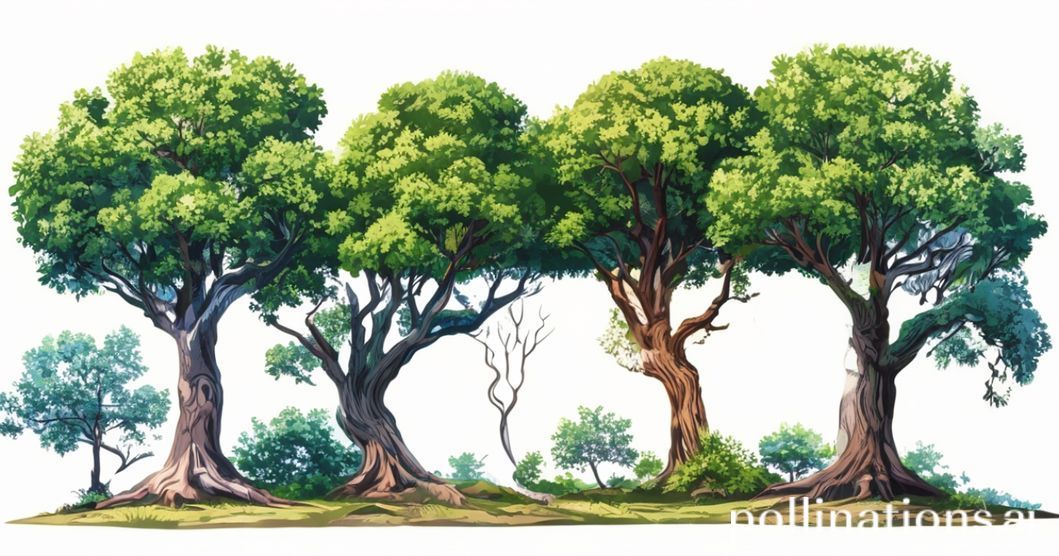
Ancient Trees – Time in a city is a blur. Things change, and we often don’t notice.
Nothing changes, and we don’t realise it. That is why I try to live near trees.
They keep time and are never in a hurry about it. It is winter in Chennai, and the Siris are dropping their leaves.
Soon, one can gaze up at the sky through their profusely branching arms, abandoned nests, and barren twigs. The trunk splits into branches and those into smaller ones; infinitely dividing themselves without ever losing proportion. Every broken branch is the tree in miniature.
Nature’s designs are full of such rhythmic, repetitive patterns called fractals — complicated mathematical models built from simple repeated shapes diminishing in size every time they are repeated. And, perhaps, fractals are not just spatial but temporal as well.
What if time were not the relentlessly ticking, linear movement we think it to be, but a 4D block where the past, present, and future co-exist? That is pretty much what long-lived trees do. They stand as silent witnesses to the passage of time, but on their own terms. Operating on principles beyond our frazzled timescales through mathematical patterns like the golden ratio.
Measuring time as a physical record through seasons and growth rings, and slow conversations through root and fungal networks. Slowness, a virtue and strategy.
Of gods and descendants India is full of old-growth trees, and the longest-lived ones often are spiritually significant. For long, it was thought that there were no trees in India that were more than a thousand years old, but that may be changing now. You have the usual suspects, the figs.
Many are Banyans (Ficus benghalensis), bustling and brooding mini-worlds of their own, spreading over acres in different parts of the country and living up to 500 years. Including the great Banyan of the Theosophical society in Chennai that once covered nearly 40,000 sq.
ft. Then there are its cousins, the Peepals (Ficus religiosa).
Like the Bodhi at Gaya, where the Buddha attained enlightenment. The present tree is only around 145 years old, but traces its direct lineage back to over 2,500 years, with descendants spreading across the world. In the high Himalayas, the magnificent Himalayan Cedars (Cedrus deodara) live up to their name as the trees of the gods.
A particular specimen in the arid zone of Lahaul in Himachal Pradesh has been reported to be more than 1,500 years old. Two particularly large specimens growing near a cluster of Shiva temples in Jageshwar in Uttarakhand are believed to be older than 900 years each.
The related Shurs or Himalayan Pencil Cedars (Juniperus polycarpos) are also very long-lived, with many individuals growing in remote high-altitude regions believed to be more than 1,000 years old as well. From Ethiopian warlords Further south in the Western Ghats is another millennia-old denizen. The Soligas of the Biligiriranga (aka BR) Hills, in southern Karnataka, centre their world and spiritual lives around the Dodda Sampige, an enormous and venerable Michelia champaca (reclassified as Magnolia champaca) tree.
The tree has a trunk that is more than 22 metres across. Meanwhile, the massive Kannimara Teak (Tectona grandis) of Parambikulam Tiger Reserve towering at nearly 45 metres is only about 500 years old. Less is known about the greybeards in the east.
A Bakhor Bengena (Divine Jasmine, Tamilnadia uliginosa), a small flowering tree in Sivasagar in Assam, has been around for more than 500 years, right from the time of the Ahom kingdom. Some of the oldest trees in India are not even Indian.
The extraordinary Baobab (Adansonia digitata) has come to India from Africa over the millennia through trade relations, through Ethiopian warlords and later the Europeans. This “tree of life” is present across the country, most notably in Mandu, but nowhere in large numbers. Many of them are known to be nearly a 1,000 years old and one unverified tree in Savanur, Karnataka, has been said to be over 2,000 years old.
Baobabs can live to be 2,500 years old. Witness protection programmes needed Globally, some of the oldest trees known include Methuselah, a more than 4,850-year-old Bristlecone pine in California and Pando, a clonal colony (genetically identical trees connected by one root system) of Quaking Aspens in Utah, the U. S.
, potentially over 10,000 years old. How long a tree lives is decided by a combination of inherent and external factors, including genetic makeup, which dictates its potential growth rate and resistance to stressors that enable them to withstand harsh conditions and resist disease, contributing to long lives.
Conversely, fast-growing species are shorter-lived. This is also likely to impact how climate change and related impacts drive tree population and ages across the world. As a direct result of their long-livedness, many trees alive today have been a silent witness to significant historical, social and ecological events.
In the U. S.
, such trees are identified and listed as ‘Witness Trees’ and receive special protection and preservation under a ‘Witness Tree Protection Program’. This is something India could potentially mimic, considering its extraordinary cultural riches and the speed at which some of them are being lost.
The complexity of the world cannot be understood fully by the limited shapes and lines of our invented geometry. Nature is wrinkled and rumpled, full of rough edges; irregular, yet perfect.
Trees are a symbol and a reminder of this and the interconnectedness of all things and need to be revered as such. The author is a birder and writer based in Chennai.