

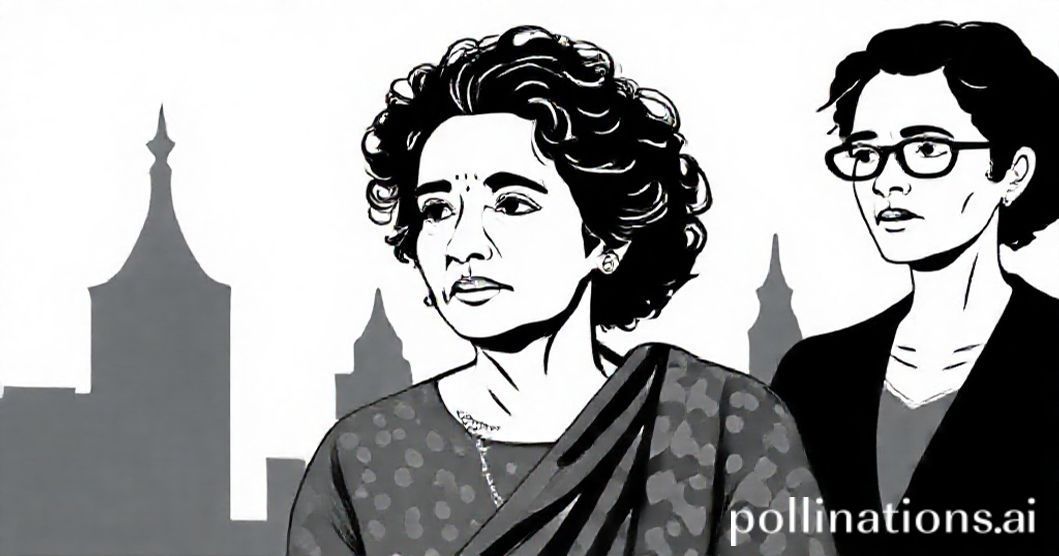
“We do not know if it is a ganja beedi… It is just too much!” These were the words of a senior lawyer making his case against an image of Arundhati Roy smoking a beedi on the cover of her new book — and by the time he’s finished speaking these words, you realise the case isn’t really about tobacco. It’s about panic, particularly the Indian variety that sees a woman with a beedi and immediately imagines the collapse of civilisation, national health policy, and possibly the rupee. The facts are boring.
A book cover shows Ms. Roy with a beedi.
The publisher adds a disclaimer saying this isn’t meant to promote smoking. But that doesn’t stop petitioners from invoking tobacco advertising.
Fortunately the courts look at the cover, recall the law, and say “relax”. Panic is rarely about facts. It’s about the delicious freedom of not knowing.
“We don’t know if it’s a ganja beedi,” the lawyer says, and in that one sentence manages to confess both ignorance and certainty. He doesn’t know — but he knows enough to be frightened.
And the less he knows, the more frightened he’s allowed to be. What if it’s a ganja beedi? What if teenagers see it? What if women see it? What if they start smoking? What if the National Tobacco Control Programme falls apart because one novelist looks “cool” on a cover? Soon, the courtroom is no longer dealing with a photograph.
It’s dealing with a fantasy — a country where a book cover overpowers public-health campaigns, parental guidance, school curricula, and common sense. Prove the unprovable Unfortunately for this fantasy (and fortunately for us), the law doesn’t operate on what-ifs. It cares about “what is”.
COTPA’s provisions on advertising are concerned with promoting tobacco products, not with whether a person somewhere might mistake a work of literature for a cigarette commercial and panic about imaginary ganja. The judges to their credit keep dragging the case back from the Republic of What-If to the Republic of India.
Is this an advertisement? No. Is the photograph being used to sell tobacco? No. Is there already a disclaimer precisely to avoid confusion? Yes.
Then the law has nothing further to say. What speculative fears do power is moral policing.
If the state can’t quite ban something on the law as written, someone can always stand up and say, “We don’t know if…” and invite the court, or the media, to fill in the gaps with anxiety. The beedi might be ganja. The book might corrupt youth.
The painting might hurt sentiments. The film might provoke violence. The joke might damage national security.
Nothing has actually happened yet, and that’s the point. The harm is always potential, latent, “out there”.
The work of art is treated as a time bomb whose existence the artist must justify while the fear is treated as self-evidently legitimate, warranting no evidence at all. Ordinarily, if you want to censor something, you must show that it crosses some legal line, e. g.
obscenity. But in the new culture of “we don’t know if…”, the artist needs to prove the unprovable: that no unknown hurt sentiment will ever surface. The fragile parent The disclaimer on Roy’s book, offered in good-faith to signal that the image isn’t an ad, is immediately reimagined as “anticipatory bail”, a confession of guilt.
It isn’t enough to clarify your intent: your very attempt to clarify becomes proof that you’ve got something to hide. Heads, the moral police wins; tails, free expression loses. None of this is accidental.
These speculative anxieties sit inside a larger political project. Call them the hidden structures (to borrow a term from physics) of our current culture wars — the background assumptions that are never litigated directly yet which shape which images are called “too much”.
Some of these structures are easy to spot. Creative freedom is becoming suspicious by default. An artist or filmmaker isn’t just making something.
They’re presumed to be smuggling in an agenda that corrupts youth and attacks the nation. Women’s autonomy in particular is always too visible! A male author with a cigarette is a trope; a female author with a beedi is “too much” — too much of a woman being at ease, too much of an author refusing to pose as a safe and respectable figure, too much of literature threatening to look like life instead of staying inside the classroom. Ultimately the state is reimagined as a fragile parent on the brink.
The government’s anti-tobacco campaigns, we’re told, can be derailed by one cover. National resolve is no stronger than a matchstick. When right-wing nationalists fight liberal ideas, they rarely say “we want fewer dissenting books”.
Instead, they say: we’re concerned about the youth, about women, about social harmony, about public health. The enemy isn’t the novel or the painting but the imaginary riot.
The beedi on Roy’s cover thus becomes part of a script in which liberal expression is always one step away from catastrophe. And the court is invited not just to read the law but to share in the anxiety. “We don’t know if it’s a ganja beedi” is a request: please, Your Lordships, join our panic.
Oddly small What’s really “too much” in this episode isn’t the beedi. It’s the ambition of a politics that wants to supervise not just what the law forbids but what your imagination is allowed to settle on without immediately reporting itself to the nearest steering committee. But when you strip away the performance you’re left with something oddly small: a misreading of a law and a plea that the courts protect citizens from the risk of misinterpreting a photograph.
In fact the Supreme Court’s response is the real satire, a measured reminder that renowned authors and publishers don’t need a beedi to sell books — and that “we don’t know if” is not a legal standard. The rest is just smoke.
mukunth. v@thehindu.
co. in.