

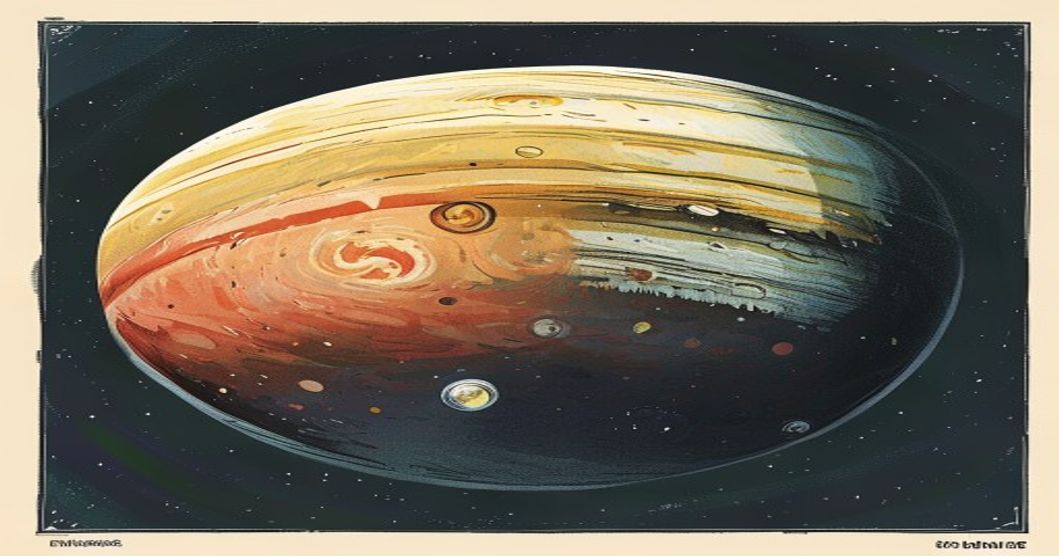
Ganymede and Callisto – The two largest planets in the solar system, Jupiter and Saturn, have huge belts of moons. However, there is a notable contradiction between them: Jupiter has four large moons, Io, Europa, Ganymede and Callisto, and the total number of all Saturn’s moons is more than 280, but Saturn has only one large moon, Titan.
What is the reason behind this contradiction? Finally, in April 2026, researchers at Kyoto University published a new study in Nature Astronomy that provides a concrete answer. According to magnetic mystery research, the reason behind this is the presence of magnetic fields around these two planets. In the beginning, when these two planets formed, there was a ring of gas and dust around them; In other words, circular discs.
Jupiter’s strong magnetic field cut off a portion of this ring, leaving an isolated area where moons could form. However, in the case of Saturn, no such region could be formed due to its weak magnetic field, so migratory moons could not form around it.
Beyond our solar system, these findings extend beyond Jupiter and Saturn. The research team’s models predict that any gas giant planet as large or larger than Jupiter would form a similarly compact, multi-moon system, and smaller Saturn-sized planets would have only one or two prominent moons.
This has important implications for the discovery of exomoons, which are moons around planets in other star systems. Our Solar System satellite systems, as the paper’s author Yuri Fujii notes, are unique, observable test beds of the theory of planet formation that would otherwise be extremely difficult to test anywhere in the universe.